
GST Rule 14A Explained: Simplified Registration, How It Works and How to Withdraw - Eligibility, process, Form GST REG-32 and common mistakes
A few weeks ago, a client called me in a mild panic. He runs a small packaging supply business, sells only to other registered businesses, and had taken a GST number in November under what his consultant called “the fast-track route.” Business had grown nicely since. Now a large buyer wanted to give him a bigger order, and his accountant said, “You may have to come out of Rule 14A.”
His first question was the one I hear most: “Come out of what, exactly? And did I do something wrong?”
He had not. Rule 14A is a convenience, and like most conveniences, it comes with an exit door. This post walks through both: how the scheme works, who can use it, and how to withdraw when your business outgrows it.
What is Rule 14A?
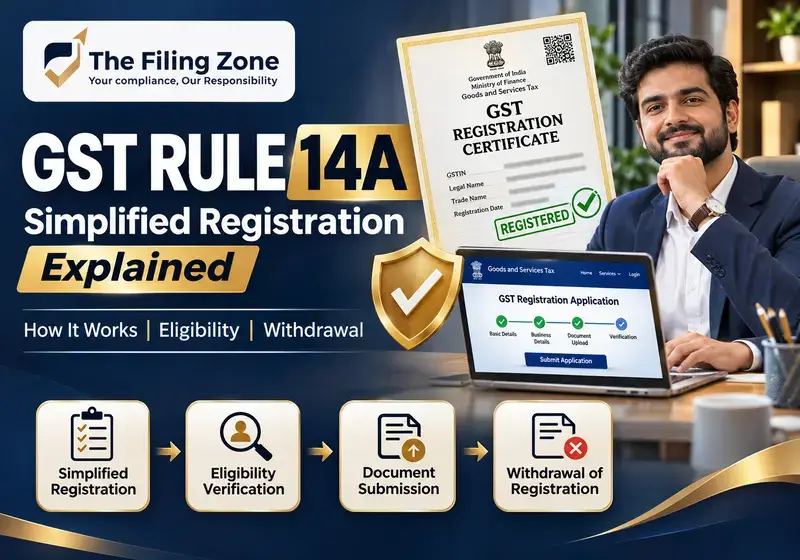
The GSTN introduced a Simplified Registration Scheme under Rule 14A of the CGST Rules, 2017, effective from 1 November 2025, to ease the compliance burden for small taxpayers. It offers a streamlined and automated registration process, ensuring faster approval and reduced documentation.
Think of it as a fast lane for very small, B2B-focused businesses. Normal GST registration can involve officer scrutiny, queries and waiting. Rule 14A removes most of that, as long as you meet the conditions.
Who is eligible?
Only taxpayers who meet both of these conditions can opt for it:
- The total output tax on supplies made to registered persons must not exceed ₹2.5 lakh in a month.
- The taxpayer must not hold more than one registration per State or Union Territory under the same PAN.
A few plain-language notes:
- The ₹2.5 lakh limit is about tax, not turnover. It includes CGST, SGST, IGST and Cess together.
- It is meant for B2B suppliers, so businesses that sell to registered buyers.
- Registration under Rule 14A is state-specific, so businesses expanding across India may need regular registration status.
How the registration works
The process is simple, which is the whole point:
- Apply on the GST portal in Form GST REG-01. Select “Yes” for Rule 14A while applying.
- Complete Aadhaar authentication. It is mandatory for the primary authorised signatory and at least one promoter or partner.
- Wait for auto-approval. Eligible taxpayers receive auto-approved registration within three days of submitting REG-01.
No long wait for an officer to review your documents. For someone starting out, that is a real relief.
A common misunderstanding: “Is the compliance lighter too?”
No, and I want to be very clear about this. The lighter process applies only to the initial grant of registration. Return filing and other ongoing duties are not lighter. You still file GSTR-1 and GSTR-3B, pay tax, and keep your records in order. Rule 14A gets you in the door faster. It does not exempt you from the house rules.
When should you withdraw from Rule 14A?
There are several situations where you will want to, or have to, step out of the scheme:
- Your monthly output tax crosses ₹2.5 lakh. If your combined CGST, SGST, IGST and Cess exceeds the limit, you no longer qualify. This is the most common reason.
- You are expanding interstate or into e-commerce. Since the scheme is state-specific, growth across states usually needs a regular registration.
- You are scaling B2B business. High-value B2B supplies may trigger system restrictions under Rule 14A. That can stop you from reporting what you actually supply.
- You want more credibility. Banks, vendors and investors may be more comfortable with a regular registration, so some businesses withdraw by choice even before they hit the limit.
The withdrawal facility: what changed in 2026
For a few months after the scheme began, taxpayers wanting to exit had no clean online route. That changed in February 2026. GSTN issued Advisory No. 650 dated 21 February 2026, enabling an online facility for eligible taxpayers to withdraw by filing Form GST REG-32 on the GST Portal.
Conditions you must meet before you withdraw
The portal checks these before it lets you submit. This is where most people get stuck, so read this section twice.
- Your registration must be active.
- No application for amendment of registration, no application for cancellation, and no cancellation proceedings initiated by the department may be pending.
- All pending returns from the date of registration until withdrawal must be filed.
- Minimum returns: If you withdraw before 1 April 2026, at least three months of returns must be filed. If you withdraw on or after 1 April 2026, at least one tax period’s return must be filed.
- No outstanding dues. There should be no outstanding tax, interest or penalties.
- Aadhaar authentication must succeed.
If any of these conditions is not met, the portal will block submission, and even one pending return will prevent you from filing REG-32. So clean up before you start.
Step-by-step: how to file Form GST REG-32
Here is the process, in the order you will see it on screen.
Step 1: Log in. Go to the GST portal, then Services → Registration → Application for Withdrawal from Rule 14A. The link is visible only if you are registered under Rule 14A and your registration is active.
Step 2: Fill the form. The field “Option for registration under Rule 14A” will be set to “No” by default. Enter the reason for withdrawal. A simple, honest reason is fine, for example “Output tax liability has exceeded the limit.”
Step 3: Complete Aadhaar authentication. It is compulsory for the primary authorised signatory and one promoter or partner, through an OTP or biometric process. The ARN is generated only after successful authentication. Make sure the mobile number linked to Aadhaar is working.
Step 4: Submit within the time limit. You can save a draft, but it expires after 15 days, so submit within that time. Note down your ARN once it is generated.
Step 5: Wait for the officer’s order. The jurisdictional officer verifies your return filing, outstanding dues and overall compliance, and issues approval or rejection in Form GST REG-33.
While your application is pending, don’t try to change your registration details. Once REG-32 is submitted and under process, you cannot make changes to your GST registration details.
Read More 👉 How to Apply for GST Registration Number in Ghaziabad
What happens after approval?
Good news: your GSTIN does not change. After approval:
- Your GSTIN remains active, the Rule 14A restriction is removed, and you can report output tax above ₹2.5 lakh.
- Upon approval through Form GST REG-33, you may furnish the specified output tax liability details from the first day of the succeeding month.
- Regular GST compliance continues, and the special monitoring under Rule 14A ends.
In other words, you carry on with the same number, minus the cap.
Why applications get rejected
From what I have seen, the reasons are almost always avoidable:
- Pending GSTR-1 or GSTR-3B
- Outstanding tax liability
- Aadhaar authentication failure
- Ongoing cancellation proceedings
- Incomplete application details
My advice is simple: treat REG-32 like a mini-audit of yourself. Check your returns, your ledger and your mobile number before you log in.
Read More 👉How to Apply for GST Registration in Noida
A practical checklist before you apply
- Confirm that every return due until today is filed.
- Check that your electronic liability ledger shows no dues.
- Verify that your Aadhaar is linked to a working mobile number.
- Make sure no amendment or cancellation request is pending.
- Review your business details on the portal for accuracy.
- Keep your reason for withdrawal short and truthful.
- Plan the timing. Because the change takes effect from the first day of the next month, applying early in the month can save you a few weeks.
Mistakes I see again and again
Waiting until the limit is crossed. Start thinking about withdrawal when your tax liability is approaching the cap, not after it is exceeded.
Filing late returns just to qualify. It is better to file honestly and pay interest than to rush wrong data into the system.
Ignoring notices. A pending cancellation proceeding blocks withdrawal completely, so respond to every notice.
Assuming Rule 14A means lower compliance. It does not. Only the registration was simpler.
Using an outdated Aadhaar mobile number. The OTP goes there, and many applications stall at this step.
Is Rule 14A right for you?
Honestly, it depends on where you are in your business journey.
It makes sense if you are a small B2B supplier, your monthly tax is well below ₹2.5 lakh, you operate from one state, and you want a quick, low-friction registration.
Think twice if you expect fast growth, plan to sell across states or online, or want to bid for tenders and larger contracts where a standard registration may be preferred.
For many people, it is a good starting point. Just remember that you may need to leave it later, and that the exit has its own conditions.
Read More 👉How to Apply GST Registration Number in Delhi
Final thoughts
Rule 14A is a useful relief for small businesses, and the withdrawal option makes it much safer to use. The new REG-32 facility turns what used to be an awkward process into a clear, online one. The key is to stay current with your returns, keep an eye on your monthly tax, and plan your exit before you are forced to.
If you are not sure whether you should withdraw, or whether your application will pass the portal checks, speak to your GST consultant before you file.
Disclaimer: This post is for general information and is based on reported GSTN advisories and notifications. Procedures, dates and conditions may change, so please check the latest provisions on the GST portal or consult a professional before acting.
Frequently Asked Questions (FAQs)
Q1. What is Rule 14A under GST?
It is a simplified registration route under the CGST Rules, effective from 1 November 2025. It offers fast, automated registration for small taxpayers whose monthly output tax on supplies to registered persons does not exceed ₹2.5 lakh.
Q2. Who can apply for registration under Rule 14A?
Taxpayers whose output tax on supplies to registered persons is up to ₹2.5 lakh a month, and who do not hold more than one registration per State or Union Territory under the same PAN.
Q3. How long does registration take under Rule 14A?
Auto-approval within three days of submitting Form GST REG-01.
Q4. Is Aadhaar authentication compulsory?
Yes. It is required for the primary authorised signatory and at least one promoter or partner. The same is needed again when you withdraw.
Q5. Does Rule 14A reduce my compliance?
No. Only the initial grant of registration is simplified. Return filing and other duties continue as usual.
Q6. What is Form GST REG-32?
It is the application you file on the GST portal to withdraw from the Rule 14A option.
Q7. What is Form GST REG-33?
It is the order issued by the officer on your withdrawal application, whether approving or rejecting it.
Q8. When should I withdraw from Rule 14A?
When your monthly output tax goes above ₹2.5 lakh, when you expand interstate or into e-commerce, when your B2B supplies grow, or when you want a regular registration for credibility.
Q9. Can I withdraw if I have pending returns?
No. Even one pending return will prevent you from submitting REG-32. File all due returns first.
Q10. How many returns must I have filed before withdrawal?
At least three months of returns if you withdraw before 1 April 2026, and at least one tax period’s return if you withdraw on or after 1 April 2026. All pending returns until withdrawal must also be filed.
Q11. Will my GSTIN change after withdrawal?
No. Your GSTIN remains active. Only the Rule 14A restriction is removed.
Q12. From when does the withdrawal take effect?
After approval in REG-33, you can furnish the specified output tax liability details from the first day of the succeeding month.
Q13. How long can I keep the REG-32 form in draft?
The draft expires after 15 days. Submit within that time to avoid losing your entries.
Q14. Can I withdraw if a cancellation proceeding is going on?
No. Withdrawal is not permitted if an amendment application, a cancellation application or cancellation proceedings by the department are pending.
Q15. What are the common reasons for rejection?
Pending GSTR-1 or GSTR-3B, outstanding dues, Aadhaar authentication failure, ongoing cancellation proceedings and incomplete application details.
The Filing Zone is a trusted platform for professional GST, income tax, and business compliance services in India. We help individuals, startups, freelancers, and businesses manage their tax and registration requirements with greater ease.
From GST registration in India and GST return filing in India to ITR filing in India, business registration, and tax compliance, our goal is to simplify complex procedures. We focus on providing practical guidance, transparent support, and convenient online assistance.
Understanding GST Rule 14A is essential for eligible businesses seeking simplified GST registration. Explore how the simplified registration process works, its eligibility requirements, and how to withdraw from the scheme with proper guidance.
Need assistance with GST registration, GST Rule 14A, or tax filing? Connect with The Filing Zone today and get professional support for your GST and income tax compliance needs.
🌐 Visit: https://www.thefilingzone.com/