
Key decisions of the meeting held on 8 October 2026, explained in plain language
If you were expecting another round of GST rate cuts from the 57th GST Council meeting, you will be disappointed. If you run a business, though, there is a lot here worth your time. This meeting was about how GST works day to day: notices, refunds, registration, returns and penalties.
The meeting was held on 8 October 2026 at Bharat Mandapam, New Delhi, under Union Finance Minister Nirmala Sitharaman. It moved the focus away from the rate changes of the 56th meeting and towards process reform and decriminalisation.
Here is what was decided, in plain language.
First, a reality check
These are the Council’s recommendations. They take legal effect only after notifications, circulars and amendments to the CGST and IGST Acts. So nothing here applies to you tomorrow morning, apart from the few dates listed near the end of this post.
No change in GST rates
The Finance Minister said that no GST rates were changed at this meeting. The Council also decided that rate matters will be taken up once a year, at a meeting meant only for rates. There are some targeted clarifications on specific goods and services, covered below.
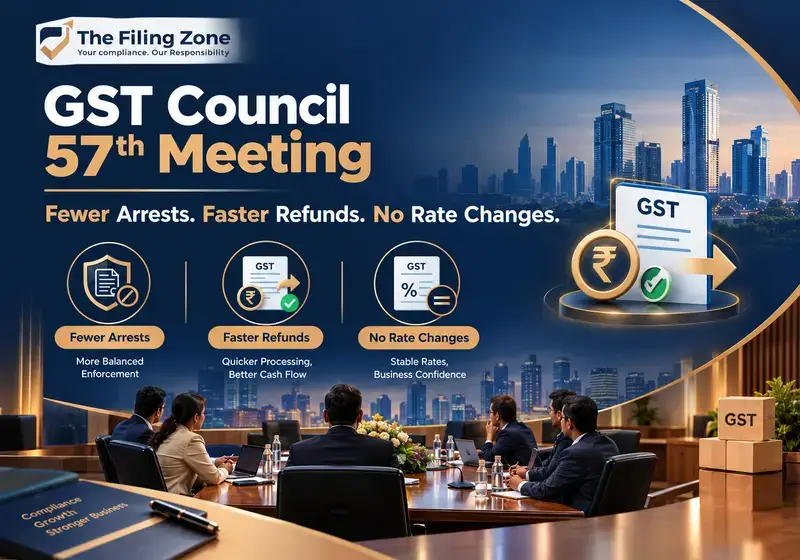
The biggest headline: no more arrest powers
The Council has proposed to omit Section 69 of the CGST Act entirely, which removes the power to arrest. It also raised the bar for prosecution. The monetary threshold under Section 132 goes up from ₹1 crore to ₹5 crore.
The offences themselves were also narrowed. Fraudulent ITC under clause (c) is now limited to cases where there is no receipt of goods or services, or no invoice or bill. The final wording will matter, so wait for the amended law before you rely on it.
Fewer notices and smaller penalties
Small-value disputes have always eaten up time and money. The Council tried to cut these down:
- No show-cause notice will be issued for demands below ₹10,000 (CGST, SGST, IGST and Cess together). Pending notices and appeals below that amount will be decided as if the limit had applied from the start.
- The maximum general penalty under Section 125 drops from ₹25,000 to ₹10,000.
- In non-fraud cases, you pay only a 5% penalty if you clear tax and interest within 30 days (Section 73) or 60 days (Section 74A) of the order.
- Pre-deposit for penalty-only appeals is capped at ₹40 crore.
- A circular will set guidelines on the quality and timeliness of notices and orders. Fraud or suppression is to be invoked only on merits.
Refunds: faster and more automatic
Refunds are where many businesses have their cash stuck, so this part matters most for working capital. The changes come in two phases.
Phase 1
- Excess balance in the electronic cash ledger is refunded automatically.
- The window for an acknowledgement or deficiency memo shrinks from 15 days to 10 days.
- For zero-rated supplies and inverted duty structure claims, 90% is sanctioned provisionally and automatically after a system risk check.
Phase 2
- Zero-rated supply refunds are sanctioned in full, net of pending dues, after the risk evaluation.
Some paperwork also goes away. Scanned uploads are no longer needed for zero-rated and inverted duty claims, and the cap limiting zero-rated goods turnover to 1.5 times the value of like domestic goods is removed.
Input tax credit: some relief
Refund of accumulated ITC is widened. Refund claims will now include ITC on input services for inverted duty structures, for credit availed on or after 1 November 2026. ITC on capital goods will also be refundable for zero-rated and inverted duty claims, spread over 60 months, for credit availed on or after 1 April 2027.
Blocked credit is eased. The Council proposed removing the Section 17(5) restrictions on outdoor catering, health and life insurance, telecom towers, pipelines outside factory premises, free samples, and goods written off on expiry of shelf life as required by law. Check the final wording before you start claiming these.
Blocking of your credit ledger. Under Rule 86A, you can object to the blocking of your electronic credit ledger and get a personal hearing before the officer decides.
Registration made easier
- All registration amendments will be auto-accepted, except a change in the principal place of business. For low-risk taxpayers, even that change will be auto-approved.
- Applications to cancel registration will be auto-accepted in two phases, once returns are filed and dues are paid.
- A new Rule 14B lets small sellers on e-commerce platforms register in states where they have no physical presence, by declaring the platform’s warehouse as their place of business. ITC passed on must stay within ₹2.5 lakh a month.
- The registration form REG-01 will be redesigned with drop-downs and tool-tips.
Return filing changes from April 2027
The aim is to cut notices caused by mismatches. The changes are proposed for returns from April 2027, after a time-bound public consultation. They include:
- Better reconciliation of GSTR-1, GSTR-1A and IFF with GSTR-3B.
- A way to correct your liability so that GSTR-3B matches GSTR-1 (Rule 61(1A)), and to correct your ITC so that it matches GSTR-2B (Rule 61(1B)).
- New electronic statements for RCM tax paid and ITC claimed (Rule 86D), and for credit reversal and reclaim (Rule 86C).
If your business is affected by return mismatches, take part in the public consultation. Businesses and industry bodies have been asked to join the consultation ahead of the April 2027 changes.
Ease of doing business
- Late fee relief. For businesses with turnover up to ₹5 crore, there is no late fee on a GSTR-3B (Section 39(1)) return filed by the end of the month in which it was due.
- Annual return, quarterly payment. The Council gave in-principle approval to an optional scheme for taxpayers up to ₹5 crore turnover who make only B2C supplies.
- Fewer roadside stops. Vehicles can be intercepted only on specific intelligence, authorised by an officer of Joint Commissioner rank or above. Inspection or detention should happen only in the state where the supplier or recipient is located or registered, not in transit states. The exception is when there is no e-way bill or no document showing origin or destination.
- E-invoicing. E-invoicing extends to RCM supplies from unregistered persons and import of services, for taxpayers with turnover of ₹5 crore and above.
Good news for exporters
- Services supplied to a foreign office or branch of the same entity can now qualify as export of services, as the Council proposed omitting Section 2(6)(v) of the IGST Act.
- Goods sold to an overseas buyer but delivered in an SEZ or FTWZ will be treated as zero-rated supplies, if payment comes in convertible foreign exchange or RBI-permitted rupees.
- A circular will clarify the foreign exchange and permitted INR receipts for exports.
Rate-related clarifications
There were no broad rate cuts, but a few specific items were settled. These are the ones most people will ask about:
- Psyllium (isabgol) seeds: nil rate.
- Toys: the rate entries cover all toys under heading 9503, not only tricycles, scooters and pedal cars.
- Delivery services through e-commerce operators: 5% without ITC, with the operator liable under Section 9(5) where the supplier is not required to register.
- Electric vehicle passenger transport and rental with operator: option of 5% with restricted ITC, where battery charging cost is included in the consideration.
- Storage of seeds for sowing and curing of coffee: exempt.
- Plastic, e-waste, tyre scrap and used cooking oil: RCM applies when supplied by unregistered persons to registered persons, with 2% TDS on B2B supplies.
Dates to note
Only three dates have been fixed so far:
|
Date |
What happens |
|
1 November 2026 |
ITC on input services availed from this date becomes refundable under inverted duty structure |
|
1 April 2027 |
ITC on capital goods availed from this date becomes refundable, spread over 60 months |
|
April 2027 return |
Revised liability and ITC correction mechanism to start, after public consultation |
What should you do now?
- Do not change your returns yet. Wait for the notifications and amended rules before you act on any of these changes.
- Check your open notices. If any demand is below ₹10,000, it may fall away once the threshold is notified.
- Review your refund claims. If you are in an inverted duty structure or export business, plan for the new refund routes from 1 November 2026.
- Look at your blocked credit. If you had stopped claiming ITC on catering, insurance or free samples, review it once the law is amended.
- Clean up your GSTR-1 and GSTR-2B data. Matching will become stricter from April 2027.
- Join the consultation if return mismatches affect you.
Final word
This meeting did not give headline rate cuts. What it did was more useful for day-to-day business: fewer arrests, fewer petty notices, faster refunds and simpler registration. As always, the real impact will depend on the final notifications, so keep an eye on them.
Disclaimer: This post summarises the Council’s recommendations as reported after the 8 October 2026 meeting. Please check the official press release and notifications, or speak to your tax consultant, before taking action.